Verifiable draws
Cryptographic randomness under a commit–reveal seed, plus an audit record of the entrant snapshot and every pick.
Drop Loop runs the hard parts of a limited-release drop — verified entrants, a drawing anyone can check, claim windows, standby promotion — behind one REST API. Plug it into your own storefront, or use the hosted one under your brand.
New to product drawings? Start here →
{
  "name": "Velocity 4 'Midnight'",
  "itemId": "item-velocity-4-midnight",
  "opensOn": "2026-10-02T14:00:00Z",
  "closesOn": "2026-10-05T14:00:00Z",
  "winnerCount": 25,
  "backupCount": 10,
  "maxEntriesPerUser": 2,
  "claimWindowHours": 48
}
Then, on our clock, to your endpoint
lottery.opened→lottery.closed→lottery.drawn→lottery.win.claimed
One request schedules the whole loop: opening, closing, the draw and every claim window run without you.
No draw code to write. No bot fight to win. No spreadsheet of winners to reconcile.
Describe the item once, then create the drop with its window, winner and backup counts, entry cap and claim window — from the admin portal or a single API call.
From your own storefront through the public drop endpoints, or from the hosted one under your brand. Every entrant verifies a phone number that can belong to only one account.
At close the draw runs and is recorded so anyone can verify it. Winners get a claim window; passes promote standbys. Your systems hear every step as a signed event.
Every integration path hits the same endpoints, so you can start hosted and go headless later without re-running a single drop.
Plans are usage-based — metered on drops drawn, entries and messages sent, never on entry fees. Drop Loop never touches payment: a claim becomes an order, and checkout stays yours.
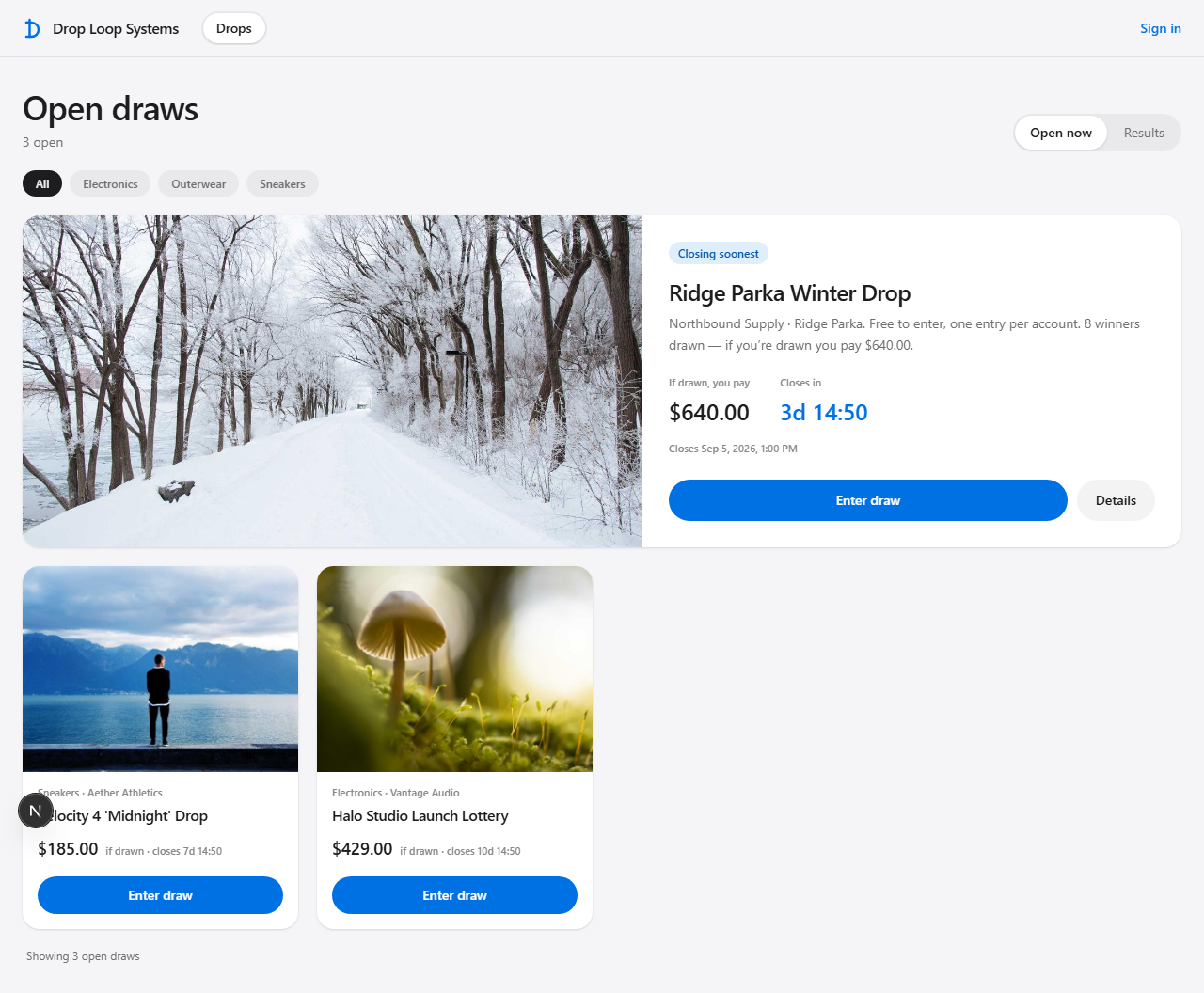
The hosted storefront — built on the same public API you get, so nothing it does is off-limits to you.
A drop isn't a one-off launch. It runs on a published schedule, every stage happens on the clock, and each one reaches your systems as a signed webhook.
lottery.opened
On schedule, published in advance. Entries are accepted until close.
lottery.closed
Entries lock and the draw’s random seed is committed as a hash, so it cannot change once the list is known.
lottery.drawn
Winners and standbys are drawn from the committed seed; the seed is revealed with the result.
lottery.win.claimed
Winners claim in their window; a pass promotes the next standby and fires its own event.
Results reveal the seed, the entrant hash and the algorithm. A public verify endpoint replays the draw with no sign-in.
Unclaimed units go down the standby list in order before they return to stock — a pass never strands inventory.
Entrants verify a phone number reserved to a single account per host. Flagged accounts and blocked identifiers never get through.
Model the drop and point your customers at it. Drop Loop handles verification, the draw, claims, inventory and every message in between.
Cryptographic randomness under a commit–reveal seed, plus an audit record of the entrant snapshot and every pick.
SMS-verified phone numbers reserved to one account, account flags and a per-host blocklist — enforced at entry and again at claim.
Split winner slots across percentage pools with eligibility rules, gate who may enter at all, and give never-won entrants bonus odds.
Offer sizes as allocations of one drop. Opening is inventory-gated, stock is decremented on claim and restored on cancel.
Results, claim notices and reminders in-app, by email, SMS and push, with per-user preferences and a live real-time hub.
Hosts, tenants, roles and permissions for your team; branding for colours and logos, down to the transactional email.
Every screen Drop Loop ships is built on the same versioned REST API you get — described in OpenAPI 3, typed for TypeScript, authenticated with scoped API keys and observed through signed webhooks.
The whole API is described in a Swagger document, and the generated TypeScript client is the one our own apps use.
A key carries only permissions its owner holds, is stored as a hash, revokes at once and keeps a usage history.
HMAC-SHA256 signatures, exponential backoff, at-least-once delivery with a stable ID per delivery to de-duplicate on.
An anonymous endpoint replays any drawn lottery from its revealed seed, so entrants can check you rather than trust you.
{
  "id": "8f3c1d2e-…",
  "event": "lottery.drawn",
  "createdOn": "2026-09-05T18:00:14Z",
  "entityType": "Lottery",
  "entityId": "velocity-4-midnight",
  "data": {
    "status": "Drawn",
    "winnerCount": 25,
    "backupCount": 10,
    "claimWindowHours": 48
  }
}
DropLoop-Signature
t=1757095214,v1=hmac-sha256
Also delivered
win.claimed · win.promoted · order.fulfilled
Get a host provisioned, an API key issued and a webhook pointed at your stack — then run a real draw end to end.